
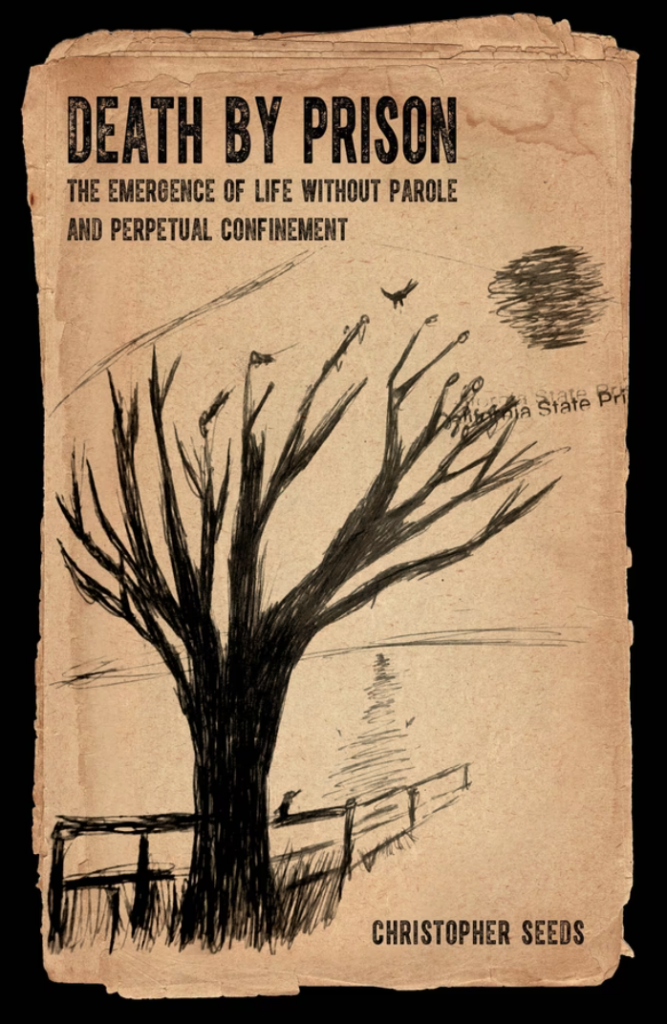
A Review of “Death By Prison. The Emergence of Life Without Parole and Perpetual Confinement,” by Christopher Seeds.
Written by Christopher Seeds, an associate professor of criminology, law, and society at the University of California, Irvine, “Death by Prison” provides an in-depth study of life without the possibility of parole (LWOP) sentencing— its origins and practices.
The LWOP sentence is a form of extreme punishment; individuals sentenced to LWOP will spend the rest of their lives in prison. Though sometimes referred to as a death penalty alternative, according to the Death Penalty Information Center, states both with and without the death penalty make use of LWOP. The only state that does not is Alaska.
This well-researched tome is divided into three major sections, outlining significant LWOP milestones. The first section focuses on the era before 1972, when there was a reasonable possibility of release through executive clemency by a state’s governor. The year 1972 is a watershed moment in the history of punishment in the U.S. because the Supreme Court temporarily invalidated the death penalty that year, with its ruling in Furman v. Georgia.
The second section covers 1972 to 1991, a period of transformation during the “tough-on-crime” era in which LWOP sentencing became a national practice. And the last section explains 1992 to 2022, as once again the death penalty waned and LWOP gained popularity as long as no possibility of release remained a salient factor.
The 1972 Supreme Court decision had a huge influence on the use of LWOP and contributed to its rise in popularity. However, this form of sentence has existed since the 19th century, and came about in conjunction with the adoption of the parole system. Four chapters are devoted to the shift in application and actual implementation of LWOP sentencing. Seeds explains how political upheavals transformed states’ and federal perceptions of LWOP as a blunt-force tool.
The “tough-on-crime” era in the 1970s and 80s found some states legislating the sentencing discretion of judges and parole administrators. Failed reform efforts created “competing toughness” on crime. Author Jonathan Simon called the tumult “governing through crime.”
The latter chapters of “Death by Prison” explore new understandings of LWOP and how the legal field impacted these practices. Seeds cites both specific state and federal case law decisions affecting the use of LWOP, and explains how these factors motivated the anti-death penalty movement.
Of particular interest is Chapter 9, “Life Prisoners, Lifetime Prisons,” which investigates how the prison system’s resistance to changing LWOP diminished in the context of rising costs of incarceration and with the prison system’s new emphasis on rehabilitation and positive programming concepts.
I dodged the death penalty by a mere four “against” votes in 1998. I should have been grateful, but perceived that those jurors should have been as friendly, deciding guilt or innocence; I only needed one to hang the jury decision. There was only one alternative: LWOP.
After 27 years in high-security California prisons as a “condemned prisoner,” my outlook has always been positive. There has been a noticeable improvement in attitudes and actions among the dozens of LWOPs I live with. The vast majority, in now-attainable low-level II prisons, see the light at the end of the tunnel of hope for eventual release. Many are now veterans of decades of self-help group participation, and a sizable portion enrolled in a multitude of college-level courses — a true club-fed-like atmosphere.
“Death by Prison” offers insight into LWOP history that many of us inside need to understand trends and practices in modern corrections. With past fluctuations of the tough-on-crime rhetoric sometimes shading efforts at positive programming to help end LWOP, this vital issue “remains a political football,” according to the book.
Seeds excellent research and 20-page bibliography includes references to books advancing life sentencing theory. Two are authored/co-authored by people actually serving life sentences. These are discussed by Seeds and, he admits, “… are, for the most part, brief and offered as a backdrop rather than introspective historical accounts…”
Several case histories are referenced throughout the text and help make this a better read for the incarcerated “legal eagles” seeking case law source material. I cannot fault “Death by Prison” for not conducting actual interviews with LWOP prisoners, since Seeds’ focus is on historical interpretation and examination. However, he also includes positive prisoner programming currently offered to LWOPs seeking resentencing to advocate abolishing the practice of “perpetual confinement,” which begs the need for first-person accounts of the effects of such positivity.
To a do-it-yourself incarcerated writ-writer trying to convince a court he should be resentenced, the history of LWOP from the early 20th century to the 2020s is irrelevant. Specific case law in such a battle is pertinent, but the courts are not tolerant of ancient arguments in current petitions.
“Death by Prison,” published in 2022, is an excellent source for abolitionist theory activists with supporting quotes like, “… over the past decade… states have abolished the death penalty at a regular clip, and in each instance LWOP has been inserted in its place.”
Progressive corrections and prison officials supporting more self-help and rehabilitative prisoner programs expect to realize budget savings by qualifying more of the incarcerated for early release — after abolishment of LWOP.
Death by prison is a solid resource for backing up these strategies.
John L. Orr writes from Mule Creek State Prison in Ione, California. Orr serves as a features reporter for the incarcerated-run newspaper Mule Creek Post. His work includes more than 150 articles for inside and outside publications, as well as a memoir, Points of Truth, and a novel, Points of Origin.