
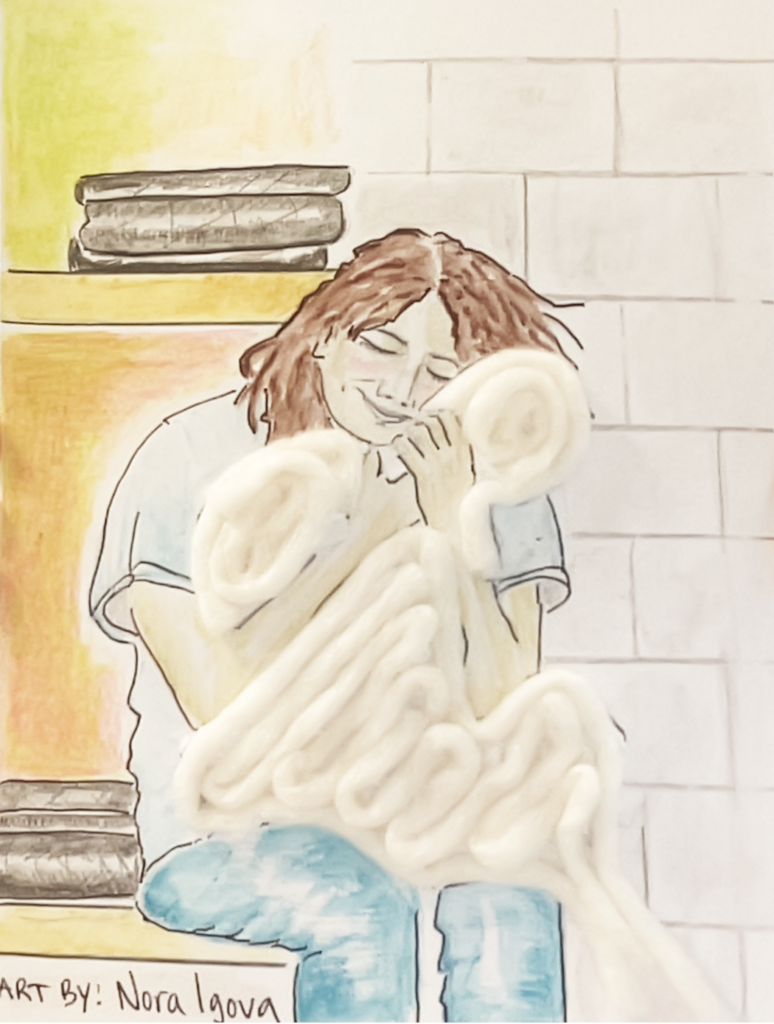
At Central California Women’s Facility, this modest household item is wonderfully comforting for an individual, but transforms an institution when shared.
When residents of Central California Women’s Facility (CCWF) arrive at the institution, they are issued state clothing and a rollup. The rollup consists of two white sheets, a pillowcase, and a drab gray acrylic blanket that resembles a cross between a sewer rat and an overused Brillo pad. It’s not an ideal choice to snuggle with every night.
Once the residents come “over the wall” (in other words, transition from reception center to general population housing), the acrylic blankets are frowned upon. Not only because of their unattractive appearance and scent, but also because of the reminder of how they made us feel when we first arrived. They signify loss of autonomy, separation from the outside world, and the act of being stripped away from everything that made us feel human. We can always tell who the new arrivals are by the black and white state-issued shoes they wear and the blanket they sleep under.
People who have been at CCWF longer use cotton blankets that, according to residents who have been here for decades, were issued by the state once upon a time in the 1990s, or allowed for purchase from a JCPenney special purchase vendor equally long ago. These blankets are white, daffodil, or butterscotch in color and represent normalcy, security, and comfort.
Cotton blankets are among our most intimate belongings. We sleep in them, cry in them, sweat in them, wrap them around ourselves during grief, and who knows what else. They are our silent companions.
They also reintroduce the ordinary into our lives. They make our cells feel less like an institutional holding space and more like lived-in rooms. They allow us to create routines around folding and washing. In this way, the blanket quietly resists institutionalization. A cotton blanket says: I am still a person living a life, not just serving time.
People claim ownership of the blankets by marking them with a permanent marker. Whether they add their name, their prison number, their nickname, or give their blanket a name (like resident Mariah Giles, who named her first blanket Binky), the label is there for the world to read.
A CCWF cotton blanket is an extremely personal item to share. It is almost as personal as lending your underwear to someone and then asking for it to be returned for the next person to use. Yet we do it because these blankets are strictly vintage. They cannot be purchased new inside the facility. We carefully wash them when they are in our possession, and carefully distribute the extras amongst us when someone leaves. Through this gentle maintenance over the years, we have been able to keep CCWF’s 2,200- plus residents covered. The cherished items get passed on from person to person, servicing everyone — short-termers, lifers, people serving life without parole, and the condemned.
Cotton blankets are among our most intimate belongings. We sleep in them, cry in them, sweat in them, wrap them around ourselves during grief, and who knows what else. They are our silent companions.
Gifting or lending someone a cotton blanket in CCWF makes a huge impact on the receiver’s life. Most individuals I interviewed remembered who gave them their first cotton blanket and how it made them feel.
For some, the blanket is not just about receiving physical warmth. The gesture says: you are seen, you are worth comfort, you are not alone here. The message carries more weight in prison because kindness is scarce and never guaranteed.
CCWF resident Victoria Fox reminisced about the first person who lent her a cotton blanket when she first came over the wall. “I felt that I was more than my crime,” Fox said. “I felt cared for.” Another resident, Jaqueline Ma, had the same kind of response. “When I covered myself with the cotton blanket, I was covered with acceptance,” Ma said. “Beforehand, all I was covered with was shame.”
Being gifted a blanket can be the first moment a person feels emotionally held after arrival. It can lower anxiety, fear, and isolation. So it makes sense that many people associate the gesture with childhood or a family connection. Christina Rivera came to CCWF two years ago, and said one of the older residents giving her a blanket “was a feeling similar to when your grandma gives you a quilt.” That gift also taught her the value of paying it forward. “I was shown kindness, and now I do the same,” she said. Rivera and her blanket sponsor still maintain a strong connection, even though the friend has paroled.
Elaine Juarez had a similar memory. When she arrived at CCWF, the residents from the first room she landed in told her acrylic blankets were not allowed in the room, so she abandoned it in the dayroom. After that, all she had with which to cover herself was her sheet. Her new roommate then checked on her, asking if she was cold. Even though she was, she claimed to be comfortable. The roommate gifted her a blanket anyway, and Juarez felt an incredible connection due to that gesture. “Since that day, I’ve claimed that person as my uncle,” Juarez said.
Shared blankets have become part of prison culture in CCWF because our ways are rooted in relational survival. At this facility, we are more likely to process trauma in community with those close to us, express care through nurturing behaviors, and create “chosen family” systems inside. The act of gifting or lending a blanket becomes a ritual of belonging. It turns the blanket into a symbol of community and resilience, not just comfort. It restores the things prisons were created to strip away.
Nora Igova writes from Central California Women’s Facility in Chowchilla, California. Igova serves as the art and layout designer on the incarcerated-run newspaper, CCWF Paper Trail.
Beautifully written! I’m a court reporter and teach it at College of Marin. I’ll be using this for dictation material for students. Thank you!