
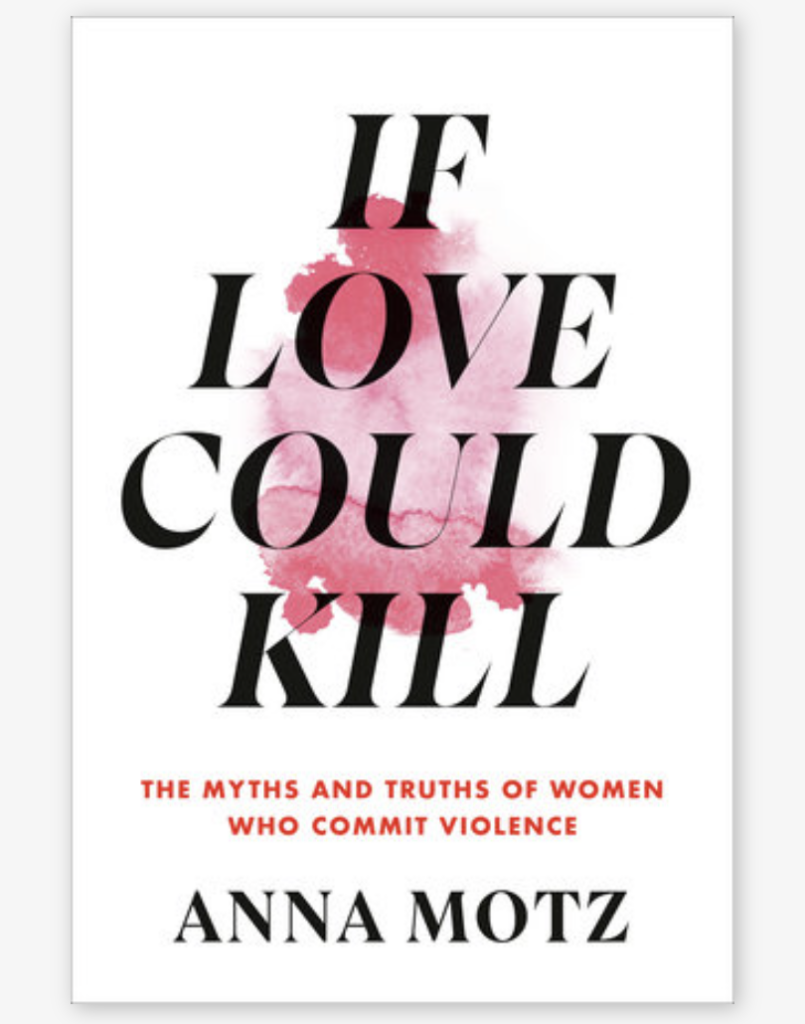
A Review of “If Love Could Kill: The Myths and Truths About Women Who Commit Violence” by Anna Motz
“If Love Could Kill: The Myths and Truths About Women Who Commit Violence” by Anna Motz is a difficult book.
It tells the stories of 10 women and how they came to be treated by Motz, a consultant clinical and forensic psychologist based in Oxfordshire, UK. Motz has spent more than 30 years working in prisons, psychiatric hospitals, and the community, with both male and female patients. But, as she outlines in this book, most of the work she has done in forensics pertains to women.
“If Love Could Kill” chronicles the violent acts that each woman committed and, more importantly, what led them to behave in antisocial manners. A 23-year-old woman called “Skye” was incarcerated for assault. But she was known to hospital staff as a chronic self-harmer who engaged in that behavior to release pain, manage her own mental anguish, and get the attention and care she craved. “Grace” was diagnosed with what was previously known as Munchausen syndrome by proxy; she deliberately made her daughter ill to feel the safety she had known as a child when she had received hospital treatment. “Tania,” who suffered a devastating sexual assault as a preteen, turned her rage outward in a horrific, prolonged attack on a man who came on to her sexually. The stories are fictionalized in parts to protect the privacy of her patients.
Placing 10 individual tragedies into a single collection makes it possible to underscore a terrible reality — that is, how often the roots of women’s violence are not only misunderstood but often mischaracterized to paint perpetrators as evil or inhuman.
Motz points to some of the roots of society’s bias and stereotypes towards women who act violently, illustrating that myths about vengeful women have existed for millennia. In the introduction, Motz references Judith beheading Holofernes in the Bible as well as the Greek tragedies of Clytemnestra, who kills Agamemnon, and of Medea, “so blinded by anger at Jason’s betrayal that she kills not only his new wife but her own children.”
While it is easy — and let’s admit it, preferable — to see these women as monsters, it’s unfair to do since it trivializes both their pain and the suffering of those they victimized.
Reading the book, I was reminded of the adage thrown around Central California Women’s Facility quite often: “Hurt people hurt people.” That is a theme underpinning “If Love Could Kill,” as trite as it may seem, but there is a lot of truth in it. Generally speaking, crimes — especially crimes of violence committed by women — do not occur in a vacuum. There is most likely something else going on, usually in the woman’s home or, most likely, something that happened to her during her formative years.
The trauma and abuse suffered by each of the 10 women underlie their actions and help provide the “why” as to why each of them acted violently. Some women turned their violence inward. This was what happened with “Mary,” whose anguish at having been the victim of incest, and later domestic violence by a partner, led to her setting fire to the curtains in her apartment, ignoring the risk the fire posed to herself and her neighbors. Others turned their violence outward, like “Dolores.” Her horrific childhood abuse led in part to an even more horrific attack on her own daughters, leaving one dead and one injured.
While it is easy — and let’s admit it, preferable — to see these women as monsters, it’s unfair to do so since it trivializes both their pain and the suffering of those they victimized. Motz takes steps to illustrate how each woman’s life experiences lead to her committing the act that led to her being treated. And, importantly, she shows how the majority of the women profiled responded well to treatment and no longer posed a danger to themselves or others after undergoing therapy.
I believe this book can help bridge the gap between what society is shown on so-called “true crime” shows and the more complicated reality experienced by each woman who acts violently. I say this as someone who committed violence and who has interacted with women who have committed violence for more than 30 years during my incarceration. I also say it as a person with a paralegal degree, which allowed me to see thousands upon thousands of pages of criminal trial transcripts and associated documents.
Though it can be read by anyone interested in the “why” of why women commit acts of violence, I would recommend this book more for people who are serious in seeking that understanding, as opposed to a casual reader. It could easily be added to a syllabus for a criminology, sociology, or psychology class, and would likely be very useful in those subjects.
Beyond the content, another difficulty worth noting is the book’s use of technical language and disparities between the criminal justice systems in the U.S. and the UK, which will be unfamiliar to a casual American reader.
“If Love Could Kill” vividly demonstrates how different the criminal justice systems are in the two countries. The UK recognizes various mental health issues that mitigate or nullify terms of imprisonment (i.e., a person can be sentenced to a psychiatric hospital until they are mentally fit to rejoin society). The mental health system in the U.S. is markedly different; it is much more difficult to establish any form of diminished capacity. Given the apparent success Motz and others have had in treating those who have been committed to psychiatric hospitals and the much lower crime statistics in the UK, this is an area worthy of further study for lawmakers and others seeking to enact meaningful criminal justice reform in the U.S.
The most difficult part for me, however, was reading each chapter with the knowledge that, though the names were fake, people — and most especially and poignantly, children — suffered in such appalling manners. And, though in some cases children were the direct victims of the women profiled, the suffering of the majority of the women themselves when they were children is equally sickening. Like me, readers might feel the need to ask themselves why over and over before the final page is turned.
Reconciling all sides of the question of “why” is the only way to develop true understanding and, as Dr. Motz writes, compassion.
Amber Bray writes from Central California Women’s Facility, Chowchilla, California. Bray is the editor-in-chief of the incarcerated-run newspaper, CCWF Paper Trail.