
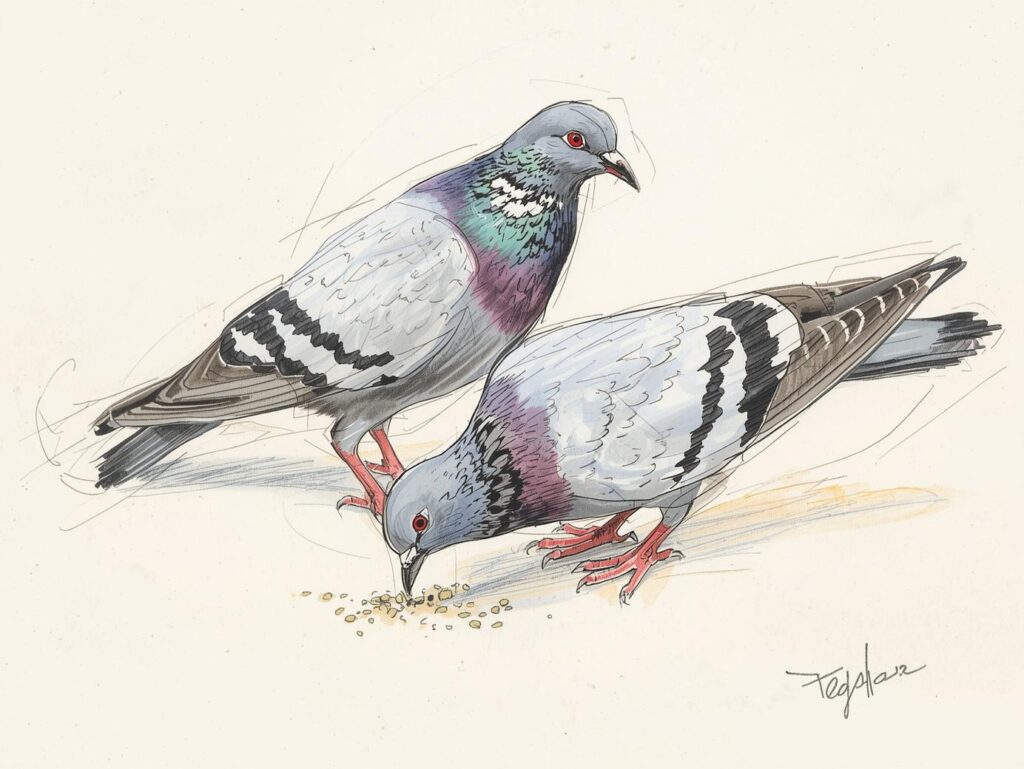
Residents of San Quentin Rehabilitation Center await their move into the newly constructed Learning Center — including the feathered ones.
California’s oldest prison overlooks San Francisco Bay, not far from where the bay meets the ocean, an area rich with bird life.
Once called San Quentin State Prison, the 176-year-old facility has recently been reimagined as the San Quentin Rehabilitation Center. Part of the ambitious modernization program is a state-of-the-art Learning Center, which has been under construction immediately adjacent to our Lower Yard since September 2024. Workers are also renovating an Upper Yard area.
Passing by the temporary barrier separating the Lower Yard from the education construction site over the past months, I haven’t seen a single pigeon perched on those new buildings. The same goes for the new yard area under construction in front of East Block — no birds.
Why is that? Just the other side of those thin barriers, birds are all around us. The barriers do not keep the birds from those spaces. Perhaps they just aren’t interested, yet, because we aren’t there.
I recently sat on a yard-side bench by the canteen, the prison version of a corner store, and opened my book to read. The Lower Yard was quiet. Most residents had gone inside to watch football. After about a paragraph, I sensed that I had company. I glanced up to see a pigeon a few feet away, looking up at me, his head cocked the way birds turn one eye on their business.
I knew that he expected food. And I knew what not to do. I did not reach into my pack for anything because birds think that means I’m digging for food. I did not pull out the snack I brought to the yard, which would have been tantamount to ringing a dinner bell.
Instead, I made a kicking motion his way. He fluttered a foot off the ground, raising a little cloud of fine dust that blew back on me, and then eased back to his spot. I offered another token kick backed up with a little vulgarity. Another brief flurry of wings spawned another cloud of dust, and he posted up in the same place. Futile.
The barriers do not keep the birds from those spaces. Perhaps they just aren’t interested, yet, because we aren’t there.
I returned to my book, but I knew he was there, eyeing me. I couldn’t focus. A witless bird had pinched my serenity, exactly what 12-step groups warn us not to allow. A couple of his associates sauntered over to join him, pigeons grouping up on the yard. But I wore them down, and weary of me, they wandered off.
A few weeks before that, I was on the yard over by the laundry room, just beyond center field. It was windy, and the birds were really active, frenetic. A couple dozen pigeons moved in unison, low and fast, with wild twists and turns. I flashed on the Hitchcock scene where seabirds cornered the schoolteacher in the phone booth and pecked her to death, filmed just a few miles up the coast, in Bodega Bay. I ducked instinctively as they surged around and past me.
They landed as a crew atop the baseball backstop. Moments later, on some covert prompt, they jumped off again in unison, tore through a crazy twisting lap, and returned to their perch. Again and again in broad sweeps across the yard, the game continued. I imagined them spiraling and corkscrewing between the tall, tightly spaced buildings in the new education center. I visualized their dozens perched atop those fancy new edifices, painting the glass exteriors white like the Cliffs of Dover.
Back to that day on the bench by the canteen: I had just about regained my tranquility, though now hosted ugly thoughts about people who feed the birds. After a couple more paragraphs in my book, the next aggressive panhandlers came into my peripheral vision; two geese were waddling over to test me. They saw the pigeons’ disappointment, but would try me anyway.
On they came, swaying like Jemima Puddle Duck. I had given up my serenity to the pigeon too easily. Now I was more chill. I coolly called them filthy pejoratives as they pushed in, each with one black eye on me. The geese are bold, like raccoons harassing a campsite. They intimidate with their bulk and big beaks, pressing in closer than pigeons. I didn’t kick at them because it raises a nasty dust cloud when the big birds beat their wings. I waited them out, and they padded away, disconsolate.
Yard recall. I didn’t get as much reading done as I had hoped. I closed my book and started picking my way across the guano-coated baseball field. Up the stairs and past the MAC Shack (where the Men’s Advisory Council works), along the tall barrier blocking my view of the construction on the Upper Yard, I continued toward South Block.
They say that the new Upper Yard area will open in September. Rumor is that it will have a roof of varicolored material, and I envision the dozens of birds that will join us under that roof, perched all around its superstructure. I picture the bird-crap that will cover the fresh concrete surface and smear the words on the signs warning us not to feed the birds.
Charles Crowe writes from San Quentin Rehabilitation Center. He is a staff writer for the San Quentin News.