

Prison transfers are a regular and sometimes dreaded occurrence, especially in California, which holds 87,000 people in its 30 men’s state prisons. What happens when an incarcerated person just doesn’t want to leave?
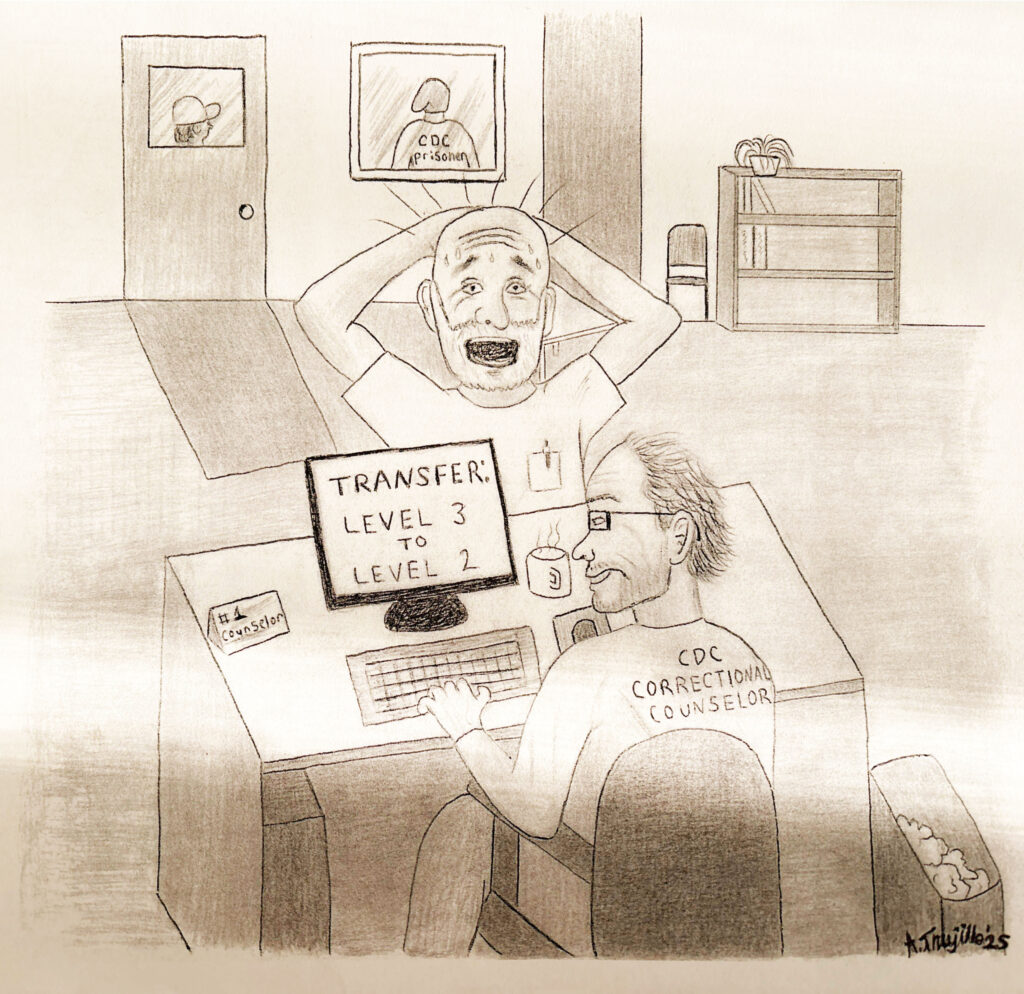
It was July 2017 when my correctional counselor at Centinela State Prison in Imperial County, close to the California-Mexican border, made an out-of-the-blue announcement: I would be transferred to a Level 2 prison, a kind he oxymoronically referred to as a “benign prison yard.”
I resisted.
California Department of Corrections and Rehabilitation (CDCR) maintains 32 prisons with varying levels of security — Level 1 for the lowest and Level 4 for the highest. I had spent my whole state sentence so far, more than 16 years, on Level 3 and 4 yards. Calipatria State Prison and Centinela State Prison were among the most insidious. Regular fights and other violence were, and still are, considered the norm. The surrounding environment is equally tough. Centinela experienced 110°F temperatures during the eight-month-long summer and blasts of icy, sandy desert winds in the winter. Despite all this, I thought I’d found my place in the Imperial Desert gravel. Was I a victim of Stockholm syndrome?
I was arrested for the first time in 1991, at age 42, in the middle of successful law enforcement and fire service careers and ended up with a life without parole sentence. Straight-arrow professionals like me are usually targets on prison yards. But I used acquired crisis intervention tactics and street-level law enforcement experiences to find my niche among the violent felons. Yard “creds” came via a few bumps, bruises and “debates” (lots of expletives!). I found good jobs and survived in tolerable two-man cells, completing my perceived sanctuary. Order was marginally maintained by correctional officers (COs) overseeing daily activities, and shot-callers — prisoners given authority by a prison gang to run the yard — ensured a semblance of peace. Our own informal police force.
“You’re going to a great place,” my youthful counselor said, “you’ve earned it — a Level 2 fire camp facility.”
The Sierra Conservation Center, located in the beautiful foothills of Northern California’s majestic Sierra Nevada mountains, is a training base for incarcerated firefighting crews.
I rebounded, challenging his abilities, including a lack of familiarity with my 1990s high-profile arson cases. But the irony of the misguided intended transfer was lost on my clueless advisor. Next I tried directly stating my opposition to an arbitrary move to the unknown. The counselor pushed back.
“When it’s your time,” he said, you’re going.”
I am a non-confrontational type, so I shook my head and walked out. Let the cards fall where they may. The counselor would be embarrassed when the erroneous transfer came to light — not my concern.
With around 87,000 men currently in CDCR custody and 30 men’s prisons to hold them, transfers are a common, if often dreaded, experience. (Women have a different experience, since there are only two CDCR women’s facilities and therefore no significant options for movement.) The department transfers people for any number of reasons, including security, overcrowding or redesign of yards. Incarcerated people can also request transfer for their own benefit — better access to programming, job training, or to be closer to family.
From what I’ve observed, transfers are generally well-intentioned to keep incarcerated people in safe environments. A transfer can be triggered by a medical diagnosis, a violent event, or even a covert, handwritten threat by another incarcerated person. An investigation ensues before notification of the move. The “California Code of Regulations, Title 15,” the correctional authority’s Bible, dictates the guidelines for transfer. But the 385-page tome is fast and loose in application, and prisoners can find themselves shuffled around based on a mix of complicated formulas and “local” (individual prison) interpretations.
Everyone’s first transfer is from jail to prison reception centers, where they are classified using the point-based CDCR Placement Score. According to the CDCR Department Operations Manual, men’s intake happens at North Kern State Prison or Wasco State Prison, and women’s at the Central California Women’s Facility. Violent offenders are initially assigned to a Level 4 yard (seven prisons have them). A person’s conduct on that yard adds or deducts points from the original total. Good conduct with no disciplinary write-ups can drop points far enough to yield the lower classification, enabling transfer to a lower Level 3 yard, and eventually to a Level 2 yard, and more privileges.
The department transfers people for any number of reasons, including security, overcrowding or redesign of yards. Incarcerated people can also request transfer for their own benefit — better access to programming, job training, or to be closer to family.
Intangible benefits on Level 2s include more access to education, job training, and more comfortable living conditions, including less regimentation at meal times. On higher security yards, prisoners must use single-file lines from portal to portal into a no-choice seating arrangement in the dining hall. They generally provide five to eight minutes to eat and get out. On Level 2, by contrast, you can take your time, have a second cup of coffee and socialize. This is a simple carrot-stick approach and produces a practical result.
In order to reach a Level 2, people must participate in classes run by the Department of Rehabilitative Programs, which can include self-help and rehabilitative groups and drug or anger management-type programs. Renouncing identified gang affiliations and security threat groups will also drop points at annual reviews. My road to Level 2, which I thought for years was unattainable, was paved with positive programming, no write-ups and maintaining a good work ethic. My cellie, on the other hand, experienced 16 years of destructive behavior in prison until renouncing his street gang affiliation — the “Golden Ticket” to lowering his score, enabling Level 2.
Level 3 and 4 yards are another story. In order to survive in these tumultuous parts of prison, individuals are forced into cliques based on a “yard code” enforced by shot-callers. Following the shot-callers’ dictates seldom results in positive outcomes for the individual. Required to shun other races, enemy gang members, homosexuals and sex offenders, the yard code sometimes forces prisoners to perform violent tasks to remain safe and protected. Anyone who has spent time on such a yard can tell you that trying to drop points to get to a safer prison yard to work towards release can seem impossible.
Frequent misconduct threatens the security of an institution and can lead to an adverse transfer, for instance, to the hole at another high-level facility — something like settling an unpaid dope debt with a knife. It’s deemed simply the cost of doing business on turbulent yards. But even at Level 3 and 4, prisoners get acclimated to their environment. They develop a circle of acquaintances, find a decent job, or enjoy convenient closeness to family residing outside the walls (which makes visits easier). Sometimes, same-sex love connections enter the equation. These are all reasons a person could shun the opportunity to move.
After walking out on my freshman counselor, I mulled over the predicament of an unwanted uprooting. I worried that the assignment oversight pre-ordained a fiasco, either mid-transfer or at the receiving prison, when more astute staff noticed the errors. After a few laps around the track in the July heat, I decided to cut the counselor some slack and returned to his office.
“You can’t send me to that Level 2. I have LWOP and arson cases,” I quietly advised, adding unnecessarily, “Imagine the headlines: ‘Convicted arsonist living in firefighter training facility.’”
I let that sink in for a beat, then muttered, “Or what happens when the fire camp staff at receiving realizes the error — it reflects on you and gets me slammed in the hole and maybe sent somewhere worse… Just let me stay here.”
The boyish advisor’s mouth dropped. “Oh crap,” he whispered, shaking his head while motioning me to take a seat, despite my heavy sweat.
While he tapped away at a few computer keys, I noticed a slight smile, then more typing. After a few seconds, he proudly announced, “You’re over 60 years old, so I can send you to a medical facility Level 2 up in the same area — Mule Creek [State Prison]. There are LWOPs all over that place!”
California currently operates several facilities with designated medical yards, designed to accommodate Americans with Disabilities Act prisoners and the aging ambulatory prison population. They are wheelchair accessible and walker-friendly. ADA caregivers are even assigned to push the mobility-challenged around the facility. Any prisoner over 50 years old, with or without a chronic illness, will eventually end up at a medical yard. Some of these Level 2s also have hospice care for an increasingly elderly population.
My counselor’s countenance told me he was committed to completing the transfer documentation. “Besides,” he said smugly, “You’ve earned a lower custody level by your clear conduct, work history and no write-ups in 15 years — take the win, man!” He missed one minor write-up, but that was irrelevant now.
He was right; I was proud of my ability to shun gangs, groups, cliques, and dumbasses detrimental to my existence. As a former peace officer, I was initially a favorite target of the shot-callers, but managed to align with safer environs. I went to a special needs yard where, theoretically, all prisoners are safe. I became a fly on the wall, blended in, and stayed off of everyone’s radar. I did not want to start all over again at a new place.
The counselor was adamant about not giving me any benefit for saving him from ridicule, so I stormed out again, still unclear about how LWOPs were Level 2 eligible.
According to two correctional counselors I interviewed recently at Mule Creek State Prison, more than 50% of incarcerated individuals elect to attend their annual classification committee review in absentia. The review is typically attended by a counselor, a disinterested captain, and possibly the incarcerated person under deliberation. A verbatim reading of the full summary takes at least five minutes, with a Q&A available at the end of the rushed event. In my experience, the typical prisoner’s view of the annual is: “I ain’t got nothin comin’ – so why go?” So we don’t.
By not attending my latest review, just two weeks before the conversation with my young Centinela State Prison counselor, I was unaware of the then-recent Title 15 LWOP revisions that now make it possible for qualified LWOP prisoners to transfer to Level 2 if the facility has a “lethal electrified fence” surrounding it.
I was also completely in the dark about Mule Creek. At Centinela, there were no brochures or informative videos about benefits at lower-level prisons. I could not find any photographs, or even a former Mule Creek State Prison resident on my Centinela yard whom I could pump for information. I could only fall back on assumptions. During my time inside, I had learned that Level 2s nearly always require dormitory living — not the relative sanctity of a two-man cell. I had lived in 40-man dorms at Lompoc Federal Penitentiary and hated the sardine-can atmosphere.
I sat down at a nearby day room table, where a raucous tribe of colleagues slammed dominoes down on a metal table top. In that clamorous atmosphere, I abandoned my normally obedient demeanor and thought like a criminal. Since my good conduct was partially responsible for the transfer, I considered reverse-engineering the situation: if I violated a rule, I would get a quick write-up, adding points to my custody score, thus negating eligibility for the move.
This approach to avoiding a transfer happens fairly often, from what I’ve observed. Those with a good job, a lucrative side hustle (legitimate or nefarious), or even the occasional love connection will use deceptive tactics to get a rules violation report (RVR), canceling out a transfer. One or two RVRs can be enough to raise the classification placement score. Small violations like being out of bounds, disobeying an order, or altering a piece of state-issued clothing can add four points to your total. A more severe RVR for theft or fighting brings even more points.
It is not uncommon for confederates to stage a fight to get the appropriate level of RVR points without requiring one to leave the yard. Drawing a little blood is acceptable, but too serious an injury could result in the aggressor losing yard privileges in the bargain. I’ve observed a half-dozen of these staged fights over the decades, and they remind me of Three Stooges bickering.
In minor skirmishes, the corrections staff generally offer the two combatants the option of signing a non-enemy chrono — aka a “marriage chrono” — a document that enables the pair to “program successfully” on the same yard. Fake fights are choreographed between people from different housing units, so the marriage does not include a relocation to another building.
Something more serious than the fake fights occurs when a Level 3 prisoner is forced to transfer to a Level 2. Immediately upon arrival, the new arrival attacks the first available resident, ideally an older or a weaker-appearing victim. The chance for such attacks has gone up since 2022, when the CDCR created a yard designation called the Non-Designated Programming Facilities (NDPF). The idea was to provide a space where more incarcerated people get access to rehabilitative programming regardless of their case factors or security level. But not everyone wants to program with people outside their group. At Mule Creek— an NDPF — several transfers from general population yards didn’t even wait to move in and attacked resident incarcerated helpers during processing in order to force another immediate transfer. I’ve witnessed three “new arrival” attacks in the past five years, two on the yard and one in an adjacent pod, where the sneak attack was on a guy using a telephone.
Still considering my self-sabotage, the following day, I did some research and discovered a startling fact. My overall score was so low, I’d have to go on a crime spree in order to jack up my score enough to derail the pending relocation. My model prisoner status was in jeopardy, so I rolled the dice, now willing to accept the transfer — as if I actually had a choice.
In August 2017, I finally ended up at Mule Creek State Prison. Like the firecamp, it is located in the foothills of the Sierra Nevada Mountains.
The Level 2 medical facility was designed for a large wheelchair- and walker-bound population. A six-man dorm, 18’ x 20’, is no bonus, but spacious picture windows and a pastoral view of the Sierra foothills make up for the spatial challenges. With a maximum capacity of 750, 250 less than the original 1000-person yards, all lines are shorter and meal time is like dining at an outside restaurant — sit where you want with whomever you choose, and go get a second cup of coffee without the fear of an overhead gun guard sighting in on you. There are no armed officers on Level 2 yards.
Yard amenities include exercycles, compression bands, Pickleball and cornhole games as well as a lush two-acre field for team sports. Mule Creek’s two Level 2 yards resemble a college campus — complete with residents dotting the yard while working on their laptops, remotely enrolled in local universities.
The CDCR would do well to advertise the advantages of Level 2 living with colorful brochures or videos on prison channels to demonstrate the impressive living conditions available by maintaining clear contact and positive programming. An abundance of self-help groups and rehabilitation activities — as well as a nationally-recognized prison newspaper, the Mule Creek Post — operate at Mule Creek. But all CDCR Level 2 yards are improving opportunities that place incarcerated people one step closer to the front gate and freedom.
The dated carrot-and-stick approach used by CDCR may not be universally accepted in its still-sprawling prison system, but the credible motivational tool is surely a win.
John L. Orr writes from Mule Creek State Prison in Ione, California. Orr serves as a features reporter for the incarcerated-run newspaper Mule Creek Post. His work includes more than 150 articles for inside and outside publications, as well as a memoir, Points of Truth, and a novel, Points of Origin.